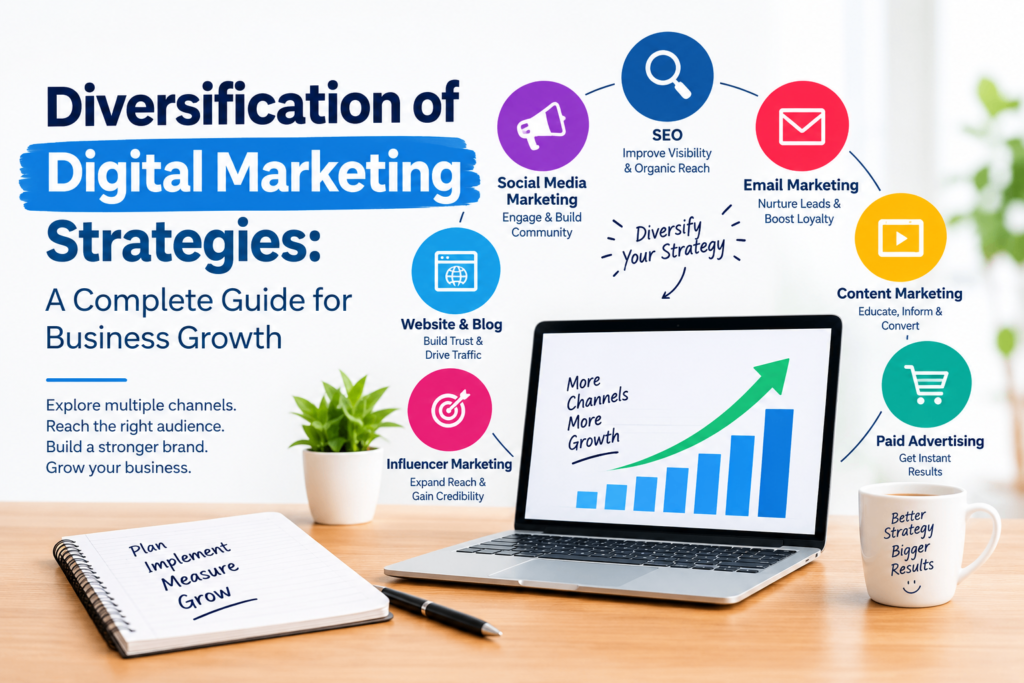
Diversification of Digital Marketing Strategies: A Complete Guide for Business Growth
In today’s competitive online environment, businesses cannot depend on just one marketing channel to attract customers and generate sales. Whether you are a startup, small business, or established company, using multiple digital marketing channels can help you reach different audiences and reduce the risk of depending on a single source of traffic. This is where Diversification of digital marketing strategies becomes important. With the support of a freelance digital marketing expert in Malappuram, businesses can develop a balanced online marketing plan that combines SEO, social media marketing, content marketing, email marketing, paid advertising, and other effective channels to achieve sustainable growth.
What Is Diversification of Digital Marketing Strategies?
Diversification of digital marketing strategies means using different digital marketing methods and platforms instead of relying on only one approach. For example, a business that depends entirely on Google search traffic may face difficulties if search algorithms change or competitors become stronger. By combining SEO with social media, content marketing, email campaigns, paid advertising, influencer marketing, and other channels, businesses can create multiple opportunities to reach potential customers.
The goal is not simply to use every marketing platform available. Instead, businesses should identify the channels that are most relevant to their target audience and use them strategically.
A diversified marketing approach can help businesses:
Reach different types of customers
Increase brand visibility
Generate multiple sources of website traffic
Reduce dependence on one marketing channel
Improve customer engagement
Increase leads and conversions
Build long-term brand awareness
Adapt to changes in digital marketing trends
Why Diversification of Digital Marketing Strategies Is Important
The digital marketing environment changes continuously. Search engine algorithms, social media trends, consumer behavior, advertising costs, and online competition can change rapidly. A strategy that works extremely well today may not deliver the same results in the future.
This is why Diversification of digital marketing strategies is becoming an important part of modern business planning.
Imagine a business that receives 90% of its website visitors from organic Google search. If its rankings suddenly decrease because of an algorithm update, the business could lose a significant amount of traffic and potential customers.
However, if the same business also has a strong social media presence, email subscriber base, paid advertising campaigns, and valuable content, it has alternative channels for reaching its audience.
Diversification therefore creates greater stability and flexibility.
Major Digital Marketing Strategies Businesses Can Diversify
There are several digital marketing channels that businesses can combine depending on their goals, industry, budget, and target audience.
1. Search Engine Optimization
Search Engine Optimization, commonly known as SEO, is one of the most important digital marketing strategies for generating organic traffic.
SEO involves optimizing a website and its content so that it can appear higher in search engine results for relevant keywords.
A strong SEO strategy may include:
Keyword research
On-page optimization
Technical SEO
Content creation
Internal linking
Local SEO
Website speed optimization
Link building
Mobile optimization
For local businesses, local SEO can be especially valuable. Optimizing a Google Business Profile, creating location-specific content, and targeting relevant local keywords can help businesses attract customers in their service areas.
2. Social Media Marketing
Social media platforms provide businesses with opportunities to connect directly with their audiences.
Platforms such as Instagram, Facebook, LinkedIn, YouTube, and other social networks can be used for different purposes.
Businesses can use social media to:
Build brand awareness
Share educational content
Promote products and services
Communicate with customers
Generate leads
Showcase customer reviews
Drive traffic to their websites
The key is to choose platforms based on where the target audience spends time rather than trying to maintain an active presence everywhere.
3. Content Marketing
Content marketing focuses on creating useful, informative, and engaging content for a specific audience.
Examples include:
Blog posts
Videos
Infographics
Case studies
E-books
Guides
Podcasts
Social media content
High-quality content can support SEO, social media marketing, lead generation, and brand authority at the same time.
For example, a digital marketing company can publish an article explaining SEO basics. That article can attract organic search traffic, be shared on social media, included in an email newsletter, and used as educational material for potential customers.
This demonstrates how different marketing channels can work together.
4. Pay-Per-Click Advertising
Paid advertising can help businesses generate immediate visibility.
Google Ads, social media advertising, display advertising, and other paid campaigns can be used to reach highly specific audiences.
Paid advertising can be particularly useful when a business:
Has a new product
Wants immediate traffic
Is launching a service
Needs more leads
Wants to target specific locations
Wants to remarket to previous visitors
However, paid advertising should be monitored carefully because continuous advertising expenses can become expensive without proper targeting and optimization.
5. Email Marketing
Email marketing is another valuable channel for maintaining relationships with customers.
Businesses can use email to send:
Newsletters
Product updates
Special offers
Educational content
Event invitations
Personalized recommendations
Follow-up messages
Unlike social media followers, an email subscriber list can provide businesses with a direct communication channel with their audience.
Building a quality email list can therefore become an important part of a diversified digital marketing strategy.
6. Video Marketing
Video has become an increasingly important way for businesses to communicate online.
Businesses can create:
Product demonstrations
Tutorials
Customer testimonials
Educational videos
Behind-the-scenes content
Short-form videos
Expert interviews
Video content can be distributed through websites, YouTube, Instagram, Facebook, LinkedIn, and other platforms.
Businesses can create
roduct demonstrations
Tutorials
Customer testimonials
Educational videos
Behind-the-scenes content
Short-form videos
Expert interviews
Video content can be distributed through websites, YouTube, Instagram, Facebook, LinkedIn, and other platforms.
It can also improve engagement and help businesses explain complicated products or services in a simple way.
How to Build a Diversified Digital Marketing Plan
Effective Diversification of digital marketing strategies requires planning. Simply opening accounts on multiple platforms does not automatically create a successful marketing strategy.
Follow these steps to build a diversified plan.
Step 1: Understand Your Target Audience
Before selecting marketing channels, identify your target audience.
Consider:
Age
Location
Interests
Buying behavior
Problems and needs
Preferred communication channels
Search behavior
Understanding your audience allows you to invest your marketing resources in the platforms that are most likely to produce results.
Step 2: Define Your Marketing Goals
Your strategy should be connected to measurable goals.
For example, your objectives could include:
Increasing website traffic
Generating more leads
Increasing online sales
Improving brand awareness
Increasing social media engagement
Growing an email subscriber list
Clear goals make it easier to determine whether your marketing activities are successful.
Step 3: Select the Right Marketing Channels
You do not need to use every available digital marketing channel.
Choose channels that match your audience and objectives.
For example:
Local business:
SEO + Google Business Profile + social media + paid search
E-commerce business:
SEO + social media + Google Ads + email marketing + content marketing
B2B company:
SEO + LinkedIn + content marketing + email marketing + webinars
The right combination depends on your business model.
Step 4: Create Consistent Content
Consistency is essential when using multiple marketing channels.
Your brand messaging, visual identity, tone, and value proposition should remain consistent across your website, social media profiles, advertisements, emails, and other channels.
However, the format should be adapted to each platform.
For example, a detailed blog post can become:
An Instagram carousel
A short video
A LinkedIn post
An email newsletter
A YouTube video
This allows businesses to get more value from a single piece of content.
Step 5: Track Performance
Data is essential for successful digital marketing.
Businesses should monitor metrics such as:
Website traffic
Conversion rate
Cost per lead
Return on advertising spend
Search rankings
Social media engagement
Email open rates
Click-through rates
Customer acquisition cost
Analytics can show which channels are producing results and which ones need improvement.
Benefits of Diversification of Digital Marketing Strategies
A well-planned diversified approach can provide several advantages.
Reduced Marketing Risk
Depending on a single channel can be risky. If that channel stops performing, your entire marketing system can be affected.
Multiple channels provide alternative sources of traffic and leads.
Wider Audience Reach
Different customers use different platforms. Some people may discover a business through Google, while others may find it through Instagram, YouTube, LinkedIn, or email.
Using multiple channels increases the chances of reaching different segments of your audience.
Better Brand Awareness
When customers repeatedly encounter your brand across different platforms, they may become more familiar with your business.
This repeated exposure can contribute to stronger brand recognition.
More Opportunities for Conversions
A customer may discover your business through an organic search result, follow you on social media, read your blog, and eventually purchase after receiving an email.
Diversified marketing creates multiple touchpoints throughout the customer journey.
Improved Adaptability
Digital marketing trends change frequently. A diversified strategy gives businesses greater flexibility when adapting to new platforms, technologies, and consumer behaviors.
Common Mistakes to Avoid
While diversification can be beneficial, businesses should avoid spreading their resources too thin.
Trying Every Platform
Being present on every social media platform does not guarantee success. Focus on channels that are relevant to your audience.
Ignoring Data
Marketing decisions should be based on performance data rather than assumptions.
Using the Same Content Everywhere
Repurposing content is useful, but each platform has different user expectations. Adapt your content accordingly.
Focusing Only on Short-Term Results
SEO and content marketing may take time to produce results, while paid advertising can provide faster visibility. A balanced strategy should consider both short-term and long-term objectives.
Not Having a Clear Budget
Every marketing channel requires resources. Establish a realistic budget and distribute it according to performance and business priorities.
The Role of a Digital Marketing Expert
Developing and managing multiple marketing channels can be challenging, particularly for small businesses and entrepreneurs.
A digital marketing professional can help with
Market research
Competitor analysis
Keyword research
SEO
Content planning
Social media management
Paid advertising
Analytics
Conversion optimization
Marketing strategy development
Working with a freelance digital marketing expert in Malappuram can be especially useful for local businesses that want personalized marketing support without the cost of maintaining a large in-house marketing team.
A freelancer can develop a strategy based on the business’s specific goals, target audience, location, competition, and available budget.
Measuring the Success of Your Diversified Strategy
The success of Diversification of digital marketing strategies should not be measured by the number of platforms a business uses.
Instead, businesses should focus on meaningful performance indicators.
For example:
Marketing Channel Important Metrics
SEO Organic traffic, rankings, conversions
Social Media Reach, engagement, leads
Google Ads Clicks, conversions, cost per conversion
Email Marketing Open rate, clicks, conversions
Content Marketing Traffic, engagement, leads
Video Marketing Views, watch time, engagement
Regularly reviewing these metrics helps businesses identify their strongest channels and improve weaker ones.
How Different Marketing Channels Work Together
One of the biggest advantages of diversification is that different channels can support each other.
For example, consider a business publishing a detailed blog about its services.
The business can:
Optimize the blog for SEO.
Share the article on Facebook and Instagram.
Create a short video based on the article.
Send the article to email subscribers.
Run paid advertisements to promote the content.
Add internal links from other website pages.
Retarget website visitors with relevant advertising.
Instead of treating every marketing channel as a separate activity, businesses can create an integrated marketing ecosystem.Future of Diversified Digital Marketing
Digital marketing will continue to evolve as technology and consumer behavior change
Artificial intelligence, automation, video content, personalization, voice search, data analytics, and emerging digital platforms are likely to influence how businesses communicate with customers.
This makes Diversification of digital marketing strategies even more relevant for businesses that want to remain competitive in the long term.
However, diversification should always be strategic. Businesses should experiment with new channels while continuing to strengthen the channels that already produce measurable results.
Conclusion
Digital marketing success does not necessarily come from focusing all your resources on one platform. Businesses need flexible strategies that can adapt to changing algorithms, customer preferences, competition, and technology.
Diversification of digital marketing strategies allows businesses to create multiple opportunities for attracting, engaging, and converting customers. By combining SEO, social media marketing, content marketing, email marketing, paid advertising, video marketing, and other suitable channels, businesses can build a stronger and more sustainable online presence.
The most important principle is to focus on quality rather than simply increasing the number of marketing channels. Understand your audience, define your goals, select the right platforms, create valuable content, monitor your performance, and continuously optimize your strategy.
For businesses looking to strengthen their online presence, working with a freelance digital marketing expert in Malappuram can provide customized guidance and practical support for creating an effective, diversified marketing plan.
A well-planned digital marketing strategy is not about being everywhere. It is about being in the right places, with the right message, at the right time.
Frequently Asked Questions
1.What does diversification in digital marketing mean?
Diversification means using multiple digital marketing channels instead of relying entirely on one source of traffic or leads. These channels can include SEO, social media, email marketing, content marketing, paid advertising, and video marketing.
2.Why should businesses diversify their digital marketing strategies?
Diversification can reduce dependency on a single marketing channel, increase audience reach, create multiple customer touchpoints, and provide greater flexibility when market conditions change.
3.Is SEO enough for a business?
SEO can be highly effective, but depending entirely on organic search can create risks. Combining SEO with other channels such as social media, email marketing, content marketing, and paid advertising can create a more balanced strategy.
4.How can a small business start diversifying its marketing?
Start with two or three channels that match your target audience and goals. For example, a local business could begin with local SEO, social media marketing, and Google Ads before expanding into other channels.
5.How often should a digital marketing strategy be reviewed?
Performance should be monitored regularly, while a broader strategy review can be conducted monthly or quarterly. This helps identify successful channels and areas that require improvement.
6. Can a freelancer manage multiple digital marketing channels?
Lorem ipsum dolor sit amet, consectetur adipiscing elit. Ut elit tellus, luctus nec ullamcorper mattis, pulvinar dapibus leo.
7.What is the most important part of a diversified marketing strategy?
Lorem ipsum dolor sit amet, consectetur adipiscing elit. Ut elit tellus, luctus nec ullamcorper mattis, pulvinar dapibus leo.